

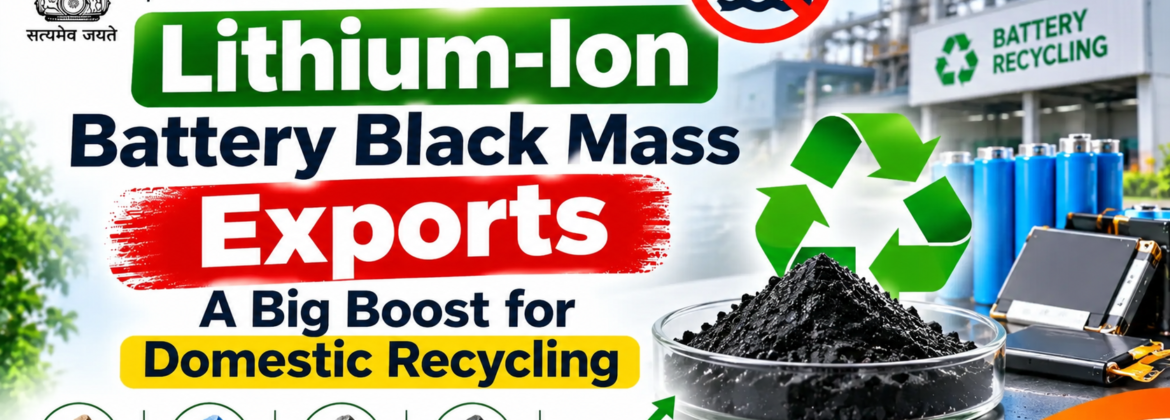
India is taking another significant step towards strengthening its domestic recycling industry and reducing dependence on imported critical minerals. On 11 November 2026, the Government of India announced a major trade policy change by prohibiting the export of lithium-ion battery black mass.
The decision is expected to strengthen India’s domestic battery recycling ecosystem, improve the availability of raw materials for recycling companies and support the country’s growing electric vehicle and energy storage industries.
This development is particularly important because lithium-ion batteries contain valuable materials such as lithium, cobalt, nickel and manganese. Recovering these materials from discarded batteries can help reduce dependence on newly mined resources and create opportunities for domestic manufacturers.
But what exactly is black mass, why has the government restricted its exports, and how could this decision affect India’s recycling industry?
Let’s understand.
What Is Lithium-Ion Battery Black Mass?
Black mass is a powder-like material obtained after end-of-life lithium-ion batteries and certain battery manufacturing waste streams undergo shredding and processing.
It contains recoverable quantities of important minerals, including:
Lithium
Cobalt
Nickel
Manganese
These materials are essential for manufacturing batteries used in electric vehicles, energy storage systems, electronics and other advanced technologies.
Instead of depending entirely on imported minerals, countries can recover some of these resources through specialised battery recycling processes.
This makes black mass an important secondary raw material in the global battery supply chain.
What Has the Indian Government Announced?
On 11 November 2026, the Directorate General of Foreign Trade (DGFT), under the Department of Commerce, announced the prohibition of exports of lithium-ion battery black mass covered under ITC(HS) Code 85491400.
The decision was notified through Notification No. 49/2026-27 dated 10 November 2026.
The export policy for the specified item was changed from ‘Free’ to ‘Prohibited’, with immediate effect and until further orders, subject to applicable transitional arrangements.
The government stated that the decision aims to retain valuable battery-recycling material within India and strengthen domestic critical mineral recovery.
Why Has India Banned Black Mass Exports?
The government identified the need to ensure that valuable secondary resources generated within India are available to domestic recycling and refining companies.
According to the Ministry of Commerce and Industry, India’s battery recycling and critical mineral refining capacity has grown, but it has not been fully utilised because of inadequate feedstock availability.
At the same time, some black mass generated in India was being exported, while domestic recyclers sometimes had to import material to meet their requirements.
The export restriction is intended to address this imbalance.
The major objectives include:
1. Strengthening domestic recycling: Keeping black mass within India can improve the availability of raw material for local recycling facilities.
2. Recovering critical minerals: More domestic processing can support the recovery of lithium, cobalt, nickel and manganese.
3. Reducing import dependence: Recovered minerals can contribute to domestic supply chains and reduce reliance on imported primary resources.
4. Supporting battery manufacturing: Recovered materials are important for electric vehicles, energy storage and advanced battery technologies.
5. Encouraging investment: Better feedstock availability may improve the commercial prospects of domestic recycling and refining facilities.
India’s ₹1,500 Crore Incentive Scheme for Critical Mineral Recycling
The export restriction complements another major government initiative: the ₹1,500 crore Incentive Scheme for Recycling Capacity under the National Critical Mineral Mission.
The scheme was approved by the Union Cabinet in September 2025 and launched on 2 October 2025.
It is designed to encourage recycling capacity for the extraction and production of critical minerals from secondary sources, including:
Electronic waste.
Spent lithium-ion batteries.
Other eligible scrap materials.
The objective is to strengthen domestic recycling infrastructure and reduce vulnerabilities in critical mineral supply chains.
The incentive scheme and the black mass export restriction represent two complementary policy approaches: developing domestic recycling capacity and improving access to suitable raw materials.
How Could This Affect Battery Recycling Companies?
The decision could create several opportunities for eligible domestic recycling businesses.
Improved raw material availability: Companies processing lithium-ion battery waste may benefit from a stronger domestic supply of black mass.
Better plant utilisation: Existing recycling facilities may have opportunities to increase utilisation if feedstock availability improves.
Technology investment: Businesses may invest in advanced extraction and refining technologies to recover critical minerals more efficiently.
Domestic supply-chain development: Battery manufacturers and material processors may benefit from a stronger domestic recycling network.
However, these benefits are not automatic. Actual commercial outcomes will depend on feedstock availability, technology, recovery efficiency, operating costs, mineral prices and regulatory compliance.
Is Battery Recycling the Same as E-Waste Recycling?
Although both industries are connected to resource recovery and the circular economy, they are not governed by exactly the same regulatory framework.
Electronic waste is covered by the E-Waste (Management) Rules, 2022.
Waste batteries are covered separately under the Battery Waste Management Rules, 2022.
This distinction is important for companies planning to enter the recycling sector because registration, compliance and operating requirements depend on the waste category and activity.
What Does This Mean for India’s Circular Economy?
The black mass export restriction highlights the importance of treating discarded products as potential sources of valuable secondary resources.
India’s transition towards electric mobility, renewable energy storage and advanced electronics will require reliable access to critical minerals.Recovering materials from batteries and electronic waste can help create a more resource-efficient industrial ecosystem.
This approach is often described as urban mining, where valuable materials are recovered from products already circulating in the economy instead of relying exclusively on newly extracted minerals.
Conclusion
India’s decision to prohibit the export of lithium-ion battery black mass is an important development for the domestic battery recycling and critical mineral recovery industry.
Combined with the ₹1,500 crore incentive scheme under the National Critical Mineral Mission, the measure signals a stronger focus on building domestic recycling capacity and improving resource security.
For recycling companies, the opportunity lies in developing suitable technology, securing reliable feedstock and maintaining strict environmental compliance.
As India’s electric vehicle and energy storage markets expand, battery recycling and critical mineral recovery are likely to remain important areas to watch
.
Frequently Asked Questions
1. What is lithium-ion battery black mass?
Black mass is a powder-like material produced during the processing of end-of-life lithium-ion batteries and certain battery manufacturing waste. It contains recoverable minerals such as lithium, cobalt, nickel and manganese.
2. When did India ban black mass exports?
The DGFT issued Notification No. 49/2026-27 on 10 November 2026, and the government announced the decision on 11 November 2026.
3. Why has India restricted black mass exports?
The objective is to improve domestic feedstock availability, strengthen recycling capacity and support the recovery of critical minerals within India.
4. What is the ₹1,500 crore critical mineral recycling scheme?
It is an incentive scheme under the National Critical Mineral Mission designed to encourage domestic recycling capacity for recovering critical minerals from secondary sources such as battery waste and e-waste.
5. Is battery waste covered under e-waste rules?
No. Waste batteries are governed separately under the Battery Waste Management Rules, 2022.
Official references: Directorate General of Foreign Trade (DGFT), Ministry of Commerce and Industry, Ministry of Mines and Press Information Bureau.

Leave a Comment