

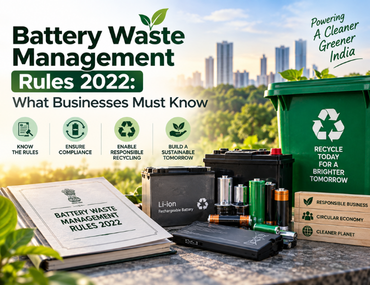
Battery Waste Management Rules 2022: What Businesses Must Know
With EV adoption and electronics use both rising fast in India, battery waste has become a regulatory priority. The Battery Waste Management Rules, 2022 set out how producers, importers, and bulk consumers of batteries — from small lithium-ion cells to large EV and lead-acid batteries — are expected to manage them responsibly.
Who These Rules Cover
The rules apply broadly: manufacturers, importers, and brand owners of all battery types (portable, automotive, industrial, and EV batteries), as well as businesses that consume batteries in bulk as part of their operations, such as telecom or logistics companies with large fleets or equipment.
The EPR Obligation for Batteries
Similar to e-waste, producers must meet annual collection and recycling/refurbishment targets for the batteries they place on the market, tracked through EPR certificates issued by authorized recyclers. This is designed to keep hazardous materials like lithium and lead out of landfills and general waste streams.
Why Rare Earth and Material Recovery Matters
Batteries — particularly lithium-ion and EV batteries — contain recoverable metals and rare earth materials that would otherwise be lost entirely if sent to landfill. Proper recycling recovers this material for reuse, which is both an environmental and a resource-security consideration for India as EV adoption grows.
What Compliance Looks Like in Practice
In practice, this means registering as a producer on the relevant portal, tracking your battery volumes, and partnering with an authorized recycler capable of processing your specific battery types and issuing valid EPR certificates against your targets.
Frequently Asked Questions
Q: Do EV battery manufacturers need to comply with these rules?
A: Yes — EV batteries are explicitly covered under the Battery Waste Management Rules, 2022, along with portable, automotive, and industrial battery types.
Q: What counts as a ‘bulk consumer’ under these rules?
A: Businesses that use large volumes of batteries in their operations — such as telecom companies, logistics fleets, or large institutions — are generally considered bulk consumers with their own obligations.
Q: Can rare earth metals actually be recovered from used batteries?
A: Yes, through proper processing, valuable materials including rare earth metals can be recovered from batteries and reused, reducing dependence on newly mined material.
Q: Who can help a business meet its battery EPR targets?
A: An authorized recycler with battery-specific processing capability — like R Planet — can manage collection, recycling, and EPR certificate issuance on your behalf.

Leave a Comment