

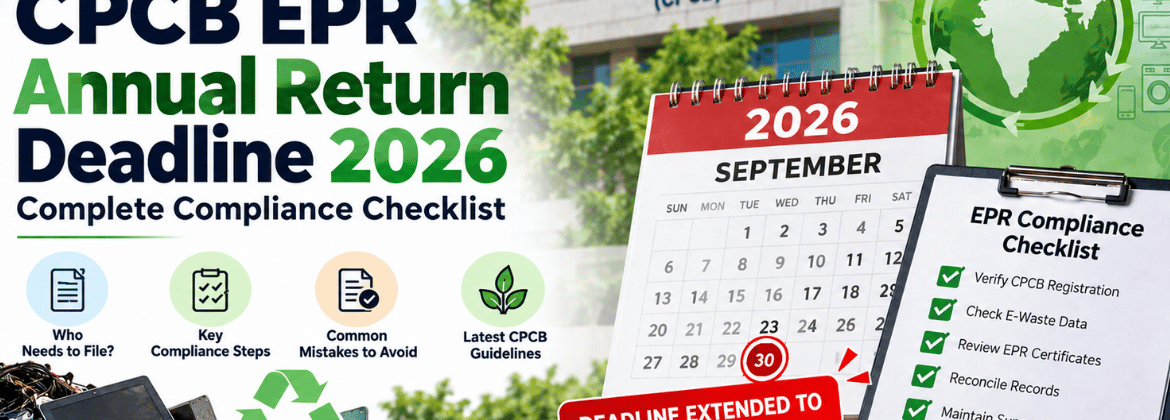
CPCB EPR Annual Return Deadline 2026: Complete Compliance Checklist
The CPCB has extended the deadline for filing Annual Returns for FY 2025–26 under the E-Waste EPR system to 30 September 2026. Here’s what businesses should check before filing.
For businesses covered by India’s E-Waste Extended Producer Responsibility (EPR) framework, the end of September is an important compliance milestone.
The Central Pollution Control Board (CPCB) has announced through its E-Waste EPR Portal that the deadline for filing Annual Returns for Financial Year 2025–26 has been extended to 30 September 2026.
If your organisation is a covered producer, manufacturer, recycler or refurbisher, this is the right time to review your records, verify your portal information and ensure that applicable returns and supporting documentation are in order.
Important: The deadline and regulatory requirements mentioned in this article are based on information available from the CPCB E-Waste EPR Portal as of September 2026. Businesses should always check the latest CPCB notices before filing.
What Is the EPR Annual Return Deadline for 2026?
The CPCB E-Waste EPR Portal currently states that the deadline for filing Annual Returns for FY 2025–26 has been extended to 30 September 2026.
This means businesses that are required to file an annual return should not wait until the last day to start checking their information.
A last-minute review can help identify issues such as:
- Incorrect company information
- Incomplete transaction records
- Missing EPR certificate information
- Differences between internal records and portal data
- Missing supporting documents
- Incorrect quantities
- Unresolved compliance information
Who Needs to Pay Attention to E-Waste EPR Compliance?
The E-Waste (Management) Rules, 2022 apply to stakeholders involved in activities including the manufacture, sale, transfer, purchase, refurbishing, dismantling, recycling and processing of covered electrical and electronic equipment and e-waste.
CPCB’s FAQ identifies the following entities as stakeholders required to register on the E-Waste EPR Portal:
-
Manufacturers
-
Producers
-
Recyclers
-
Refurbishers
The exact compliance obligations depend on the role of the organisation.
For example, producers have EPR obligations related to the recycling of covered electrical and electronic equipment, while recyclers have their own registration, reporting and record-keeping requirements.
What Is EPR in E-Waste Management?
Extended Producer Responsibility (EPR) is a framework under which producers of covered electrical and electronic equipment have defined responsibilities for managing the environmental impact of their products after use.
Under India’s E-Waste Management Rules, 2022, producers are required to meet applicable recycling obligations through the EPR framework.
CPCB explains that producers fulfil their EPR obligations through EPR certificates generated through the E-Waste EPR system and purchased from registered e-waste recyclers, subject to the applicable rules and portal processes.
The rules came into effect from 1 April 2023 and replaced the earlier E-Waste Management Rules, 2016.
EPR Annual Return 2026: What Should Businesses Check?
Before filing an annual return, businesses should conduct an internal compliance review.
Here’s a practical checklist.
1. Check Your CPCB Registration
Confirm that your organisation’s registration details on the E-Waste EPR Portal are correct.
Check details such as:
-
Company name
-
Registered address
-
Contact details
-
Authorised representative
-
Registration details
-
Applicable stakeholder category
If any information is outdated, check the CPCB process for making the appropriate update.
2. Review Your E-Waste Data
Your internal records should be consistent with the information being reported.
Review:
-
E-waste quantities
-
Product categories
-
Collection/procurement records
-
Recycling information
-
Relevant transaction records
-
Applicable EPR obligations
Maintain supporting records for the figures reported.
3. Check EPR Certificates
Where applicable, review the EPR certificates associated with your compliance activities.
CPCB’s guidance states that EPR certificates are generated through the portal based on qualifying recycling information submitted by registered recyclers.
Producers should therefore ensure that applicable EPR transactions and records are properly reconciled.
4. Reconcile Your Internal Records
One of the most important steps is comparing your internal data with your portal and compliance records.
For example:
Internal records → invoices → collection/recycling records → EPR records → portal information
If there are differences, investigate them before submitting the return.
5. Check Supporting Documents
Keep relevant documents organised and accessible.
Depending on the stakeholder and activity, these may include:
-
Purchase records
-
Sales records
-
E-waste collection records
-
Recycling records
-
Invoices
-
EPR certificate information
-
Processing records
-
Transportation documentation
-
Other applicable compliance documents
CPCB guidance for recyclers specifically emphasises maintaining records relating to e-waste collected/procured, recycled and end products produced and sold.
What Records Should E-Waste Recyclers Maintain?
For recyclers, accurate records are particularly important.
CPCB guidance states that registered recyclers need to upload information relating to quantities of e-waste procured/collected, recycled and end products produced and sold on the E-Waste EPR Portal.
The guidance also highlights the importance of:
-
Maintaining procurement and sales invoice sequences
-
Keeping records of e-waste collected or procured
-
Maintaining recycling quantities
-
Maintaining records of end products
-
Uploading relevant invoices
-
Ensuring the correctness of submitted information
-
Keeping records available for verification or audit
This makes internal data management an important part of EPR compliance.
6 Common EPR Compliance Mistakes Businesses Should Avoid
Mistake 1: Waiting Until the Deadline
The biggest practical problem with a deadline is leaving everything until the final day.
Instead, conduct a compliance check before submission.
Mistake 2: Using Different Numbers in Different Records
Your internal records, invoices and portal information should be properly reconciled.
Differences can create unnecessary compliance questions.
Mistake 3: Ignoring Supporting Documents
Don’t treat the return as simply an online form.
Maintain the records that support the information being submitted.
Mistake 4: Confusing EPR Registration With Complete Compliance
Registration is an important part of the EPR framework, but it should not automatically be treated as the completion of every applicable obligation.
Businesses should review their specific responsibilities under the applicable rules and CPCB requirements.
Mistake 5: Choosing an Unregistered Recycling Partner
CPCB’s E-Waste Management Rules framework places importance on registered recyclers for EPR-related recycling activities.
Businesses should therefore verify the relevant registration and compliance status of their recycling partner.
Mistake 6: Not Keeping an Audit Trail
Maintain a clear record of:
What was collected → What was processed → What was recycled → What certificates/records were generated → What was reported
A clear audit trail makes future verification easier.
EPR Annual Return 2026: Quick Checklist
Before filing, ask:
| Check | Done? |
|---|---|
| CPCB registration verified | ☐ |
| Company information checked | ☐ |
| Applicable EPR obligations reviewed | ☐ |
| E-waste quantities reconciled | ☐ |
| Internal records checked | ☐ |
| Invoices organised | ☐ |
| EPR certificate information checked | ☐ |
| Recycling records verified | ☐ |
| Portal information reviewed | ☐ |
| Annual Return prepared | ☐ |
| Submission acknowledgement saved | ☐ |
| Supporting documents archived | ☐ |
What Happens If Compliance Is Not Properly Maintained?
EPR compliance is not only about submitting a form.
The E-Waste Management Rules include provisions concerning environmental compensation for certain non-compliances, and CPCB has published environmental-compensation guidelines covering violations including failures related to annual and quarterly returns.
The exact consequences depend on the applicable provision and circumstances.
Therefore, organisations should review their obligations carefully and avoid treating the annual return as a last-minute administrative exercise.
How Can R Planet Help With E-Waste Management?
Managing e-waste compliance can involve more than simply arranging disposal.
Businesses may need support with:
-
E-waste collection
-
Reverse logistics
-
Responsible recycling
-
Data destruction
-
IT asset disposal
-
EPR-related compliance support
-
Documentation
-
Recycling records
-
Corporate e-waste management
R Planet Integrated Solutions Pvt. Ltd. provides e-waste management and recycling solutions for businesses.
For organisations looking to establish a more structured e-waste management process, the right approach is to connect collection, logistics, secure data handling, recycling and documentation into one controlled workflow.
Frequently Asked Questions
What is the EPR annual return deadline for FY 2025–26?
According to the CPCB E-Waste EPR Portal, the deadline for filing Annual Returns for FY 2025–26 has been extended to 30 September 2026.
Who needs to register on the E-Waste EPR Portal?
CPCB’s FAQ identifies manufacturers, producers, refurbishers and recyclers as entities required to register on the E-Waste EPR Portal under the E-Waste Management Rules, 2022.
What is EPR in e-waste management?
EPR stands for Extended Producer Responsibility. It places defined responsibilities on producers for managing the environmental impact of covered electrical and electronic equipment under the applicable regulatory framework.
What is an EPR certificate?
An EPR certificate is generated through the CPCB E-Waste EPR system based on qualifying recycling activity reported by registered recyclers. Producers can use applicable EPR certificates to fulfil their obligations in accordance with the rules and portal process.
Do recyclers also have reporting responsibilities?
Yes. Registered recyclers have reporting and record-keeping responsibilities under the E-Waste Management Rules and CPCB’s EPR portal processes.
Is the 30 September 2026 deadline applicable to every type of EPR?
No. The deadline discussed in this article relates specifically to the E-Waste EPR Annual Return for FY 2025–26. Other waste streams, such as batteries or waste tyres, operate under separate regulatory frameworks and portals.
Where can I check the latest CPCB E-Waste EPR information?
Businesses should check the official CPCB E-Waste EPR Portal for the latest notices, filing information and regulatory updates.
Final Takeaway
The 30 September 2026 deadline makes this an important time for organisations covered by India’s e-waste EPR framework.
Instead of waiting until the last day, businesses should review their registration, EPR obligations, recycling records, certificates, invoices and supporting documentation and ensure that the applicable Annual Return information is accurate.
For organisations that generate significant volumes of electronic waste, EPR compliance should be treated as an ongoing process rather than a once-a-year filing exercise.
Need help managing your business’s e-waste? Connect with R Planet for professional e-waste recycling, reverse logistics, data destruction and compliance-related services.
Source: Central Pollution Control Board – E-Waste EPR Portal.

Leave a Comment