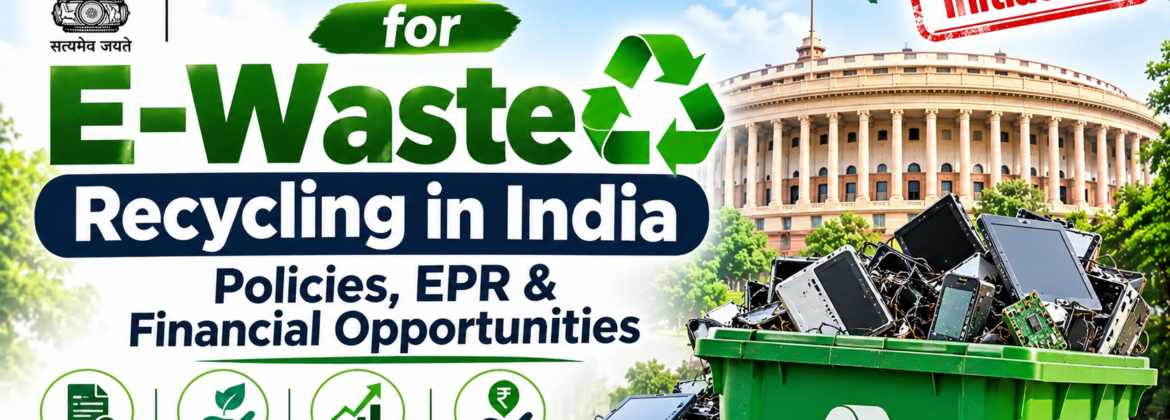
India’s growing use of electronic products has made responsible e-waste management an important environmental and industrial priority. Discarded electronics can contain valuable recoverable materials, but unsafe handling and disposal can create risks for people and the environment. The Government of India has responded through regulations, producer responsibility, digital compliance systems and broader circular-economy initiatives. For entrepreneurs, it is important to distinguish between a regulatory framework, a policy initiative and a direct financial subsidy.
1. E-Waste (Management) Rules, 2022
The E-Waste (Management) Rules, 2022, effective from 1 April 2023, provide the central regulatory framework for covered electrical and electronic waste. They establish registration and compliance requirements for specified manufacturers, producers, refurbishers and recyclers.
The rules place Extended Producer Responsibility at the centre of the system. Eligible producers must meet prescribed obligations through the mechanism set out in the rules and CPCB procedures.
2. Extended Producer Responsibility: A Compliance-Linked Mechanism
Under EPR, eligible producers are responsible for meeting their prescribed end-of-life management obligations. Registered recyclers that carry out eligible recycling activity may generate EPR certificates under the applicable process.
Producers can use eligible certificates to fulfil their obligations. This creates a compliance-linked market for recycling services, but it should not be confused with a direct government grant or guaranteed income for every recycler.
3. CPCB’s Digital E-Waste EPR Portal
The Central Pollution Control Board’s E-Waste EPR Portal is the key online platform for the registration and compliance processes under the rules. It provides access to stakeholder registration, reporting and certificate-related functions, along with directions and guidance.
Businesses should use the portal and current CPCB notifications to confirm the latest registration process, documentation and operating requirements.
4. Circular-Economy Policy and NITI Aayog
Circular-economy initiatives focus on keeping materials and products in use for longer through repair, reuse, refurbishment, recycling and resource recovery. E-waste is one of the important streams in this wider policy discussion.
NITI Aayog publications and policy work can help businesses understand the broader direction of India’s circular-economy transition. Such reports are policy and research resources; they should not automatically be interpreted as funding schemes.
5. Government Offices and Responsible E-Waste Disposal
Government departments and public institutions can contribute by identifying obsolete electronic equipment, maintaining inventories and arranging responsible handover to appropriate authorised channels.
Public-sector collection and disposal campaigns can help improve awareness and create better practices for managing redundant computers, printers, networking equipment and other electronics. The exact requirements depend on the relevant campaign instructions and procurement or disposal rules.
6. Environmental Compliance and Accountability
The rules include compliance and enforcement mechanisms. CPCB and State Pollution Control Boards have roles in monitoring and implementing environmental requirements. CPCB also publishes guidance related to environmental compensation under the e-waste framework.
Recycling businesses should budget for environmental permissions, pollution-control systems, worker safety, record keeping and residue management. Compliance is part of the operating model, not an optional extra.
7. Is There a Direct Subsidy for Starting an E-Waste Recycling Plant?
There is no single universal subsidy that automatically applies to every e-waste recycling plant in India. Financial support, where available, depends on the specific scheme, state policy, applicant category, project activity, investment type and current eligibility conditions.
Entrepreneurs should investigate relevant central and state MSME programmes, industrial policies, technology-support programmes and financing options. They should obtain written confirmation from the implementing agency before including any subsidy in a project’s financial projections.
8. How Entrepreneurs Can Explore Support
Before applying for assistance or setting up a facility, entrepreneurs should prepare a project report covering the waste stream, collection plan, process technology, installed capacity, land and utilities, environmental safeguards, capital expenditure, operating costs and buyers for recovered materials.
They should then check the current requirements with the relevant State Pollution Control Board, CPCB, state industry department and the agency administering any proposed scheme. A project should remain financially viable even if a grant or incentive is delayed or unavailable.
Conclusion
India’s e-waste ecosystem is supported by a combination of regulation, EPR obligations, digital monitoring and circular-economy policy. These mechanisms encourage responsible recycling and help create a more organised market for eligible recycling services.
For entrepreneurs, the opportunity is to build a compliant operation with reliable collection, suitable technology and transparent material recovery. Before relying on any government subsidy, applicants should verify the current scheme notification and eligibility directly with the responsible authority.
Editorial note: This article is for general information and educational purposes. Regulations, portal procedures and government programmes may change. Verify the latest official notifications before relying on any compliance or financial information.