

What Is a Circular Economy — and Why Should Your Business Care?
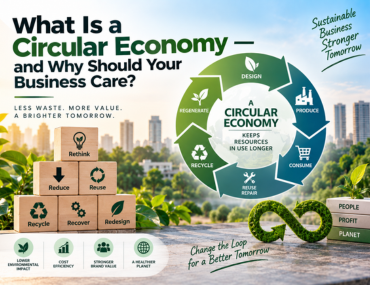
‘Circular economy’ gets used a lot in sustainability conversations, but the concept itself is fairly simple: instead of the traditional take-make-dispose model, a circular economy keeps materials in use for as long as possible — through reuse, recovery, and recycling — rather than treating waste as a dead end.
The Linear Model vs. the Circular Model
In a linear model, raw materials are extracted, turned into products, used, and then discarded — usually to landfill. A circular model closes that loop: materials recovered at end-of-life are fed back into new products, reducing the need for virgin raw material extraction altogether.
Why This Matters Beyond Sustainability Optics
Circularity isn’t just an environmental talking point — it has real business implications. Recovering materials can reduce raw material costs over time, reduce exposure to supply chain volatility, and increasingly, align with what regulators and large customers are starting to expect from their suppliers.
What Circularity Looks Like in Practice
For most businesses, this starts small: identifying which materials in your product or packaging can realistically be recovered and recycled, and building relationships with recyclers who can close that loop — rather than treating end-of-life material as someone else’s problem.
Getting Started Without Overhauling Everything
You don’t need to redesign your entire product line to start. Mapping your current material flows and identifying the highest-impact recovery opportunities is usually the most practical first step, and it’s where a circularity consulting partner can add the most value early on.
Frequently Asked Questions
Q: What is the simplest definition of a circular economy?
A: An economic model that keeps materials in use through reuse, recovery, and recycling, instead of the traditional ‘take, make, dispose’ approach.
Q: Is circular economy just a sustainability buzzword?
A: It has real practical implications — including potential cost savings from material recovery and reduced dependence on raw material supply chains — beyond just environmental messaging.
Q: How does a business start building circularity into its operations?
A: Typically by mapping current material flows, identifying what can realistically be recovered or recycled, and partnering with recyclers who can close that loop.
Q: Does circular economy consulting replace our existing recycling arrangements?
A: No — it’s designed to work alongside existing recycling and EPR programs, identifying additional opportunities rather than replacing what’s already working.

Leave a Comment